Can a Dietitian Help with Body Image?
Although the word “dietitian” literally has the word “diet” in it, folks are often surprised in working with me how little we can talk about food itself. I’ve even had professionals I collaborate with to expect a large part of my work with clients to be focused on meal planning and dietary assessment.
Don’t get me wrong- that is often part of the discussion- but there’s a lot of confusion about what dietitians do. In fact, I didn’t fully understand until I took an introduction to the dietetics profession class! I assumed I had most of the knowledge I needed before I even enrolled in my program because I had a degree in exercise and nutrition science. Spoiler alert: I didn’t know how little I knew.
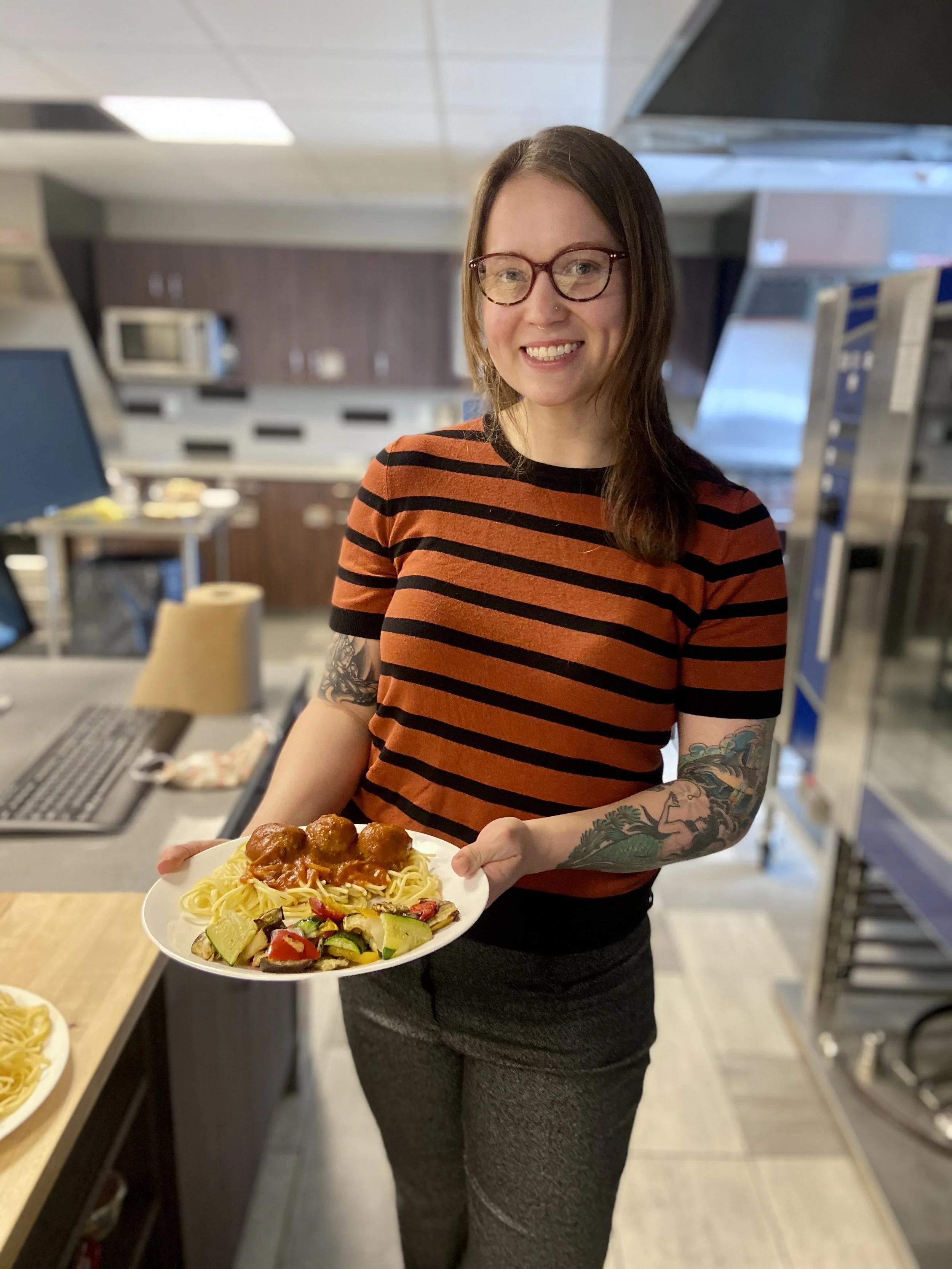
In dietitian school posing with food used for a local news segment. The meatballs were still frozen inside. Whoops!
Without getting into the nitty gritty of our schooling, the education to become a dietitian is very broad. Our classes range from organic chemistry and microbiology to food service management. While most dietitians graduate and work in clinical nutrition- i.e. disease management and prevention through nutrition- many go on to work in community settings, as educators, food scientists or researchers, and in management positions. One of the things I genuinely love about my profession is how many options there are once you graduate.
Once you pass your board exam, you are “entry level” wherever you end up working. The Academy of Nutrition and Dietetics (AND) describes this as the “competent” level of dietitian. We should be able to do the basics in our chosen field. As you advance within your role, you become “proficient” and then “expert” level.
Scope of practice is dependent on many factors- experience, skills, advanced training or certification, and supervision. There are limits to this, of course- just because I learn about medication doesn’t mean I can prescribe it. Similarly, just because one dietitian can do something, it doesn’t mean every dietitian can or should.
At the competent level of an eating disorders dietitian, we are focusing on building motivation, determining nutrition needs, and assessing how someone feels about their weight or body shape- but we may not have the skill set to incorporate therapeutic modalities or tackle body image head on yet[1]. I knew when I was doing this early work that I was helpful, but not yet practicing to the edge of my capacity as a dietitian.
I’ve completed advanced training, and have dedicated thousands of hours and dollars to be able to work more deeply with clients using varying therapeutic modalities. I have always been obsessed with understanding why people behave the way that they do, especially when it comes to health behaviors like nutrition and exercise. This is part of why I ended up specializing in eating disorders- it’s one end of a spectrum where nutrition behaviors may be actively harming someone, and yet they can’t “just eat”.
What I know intimately now: how you nourish your body is directly linked to how you feel about it. This is body image work.
Body image is the relationship you have with your body: how you perceive it, how you feel about it, how you believe others perceive it, and how those beliefs influence your behavior.
There are many factors that influence body image, including trauma history and interpersonal dynamics. Those pieces are truly out of my wheelhouse and are best left to the work of a skilled therapist, but many other aspects are soundly within my scope of practice. This might include unpacking beliefs and assumptions about bodies and weight that you’ve inherited from your family of origin or sport. It might revolve around building awareness of how body image distress shows up for you, and why. There may also be work that we do around cultivating body appreciation and acceptance. These are all in service of building eating competency and in many cases lead to improved eating habits.
In my work, I help folks figure out what is getting in the way of making nutrition changes and reducing the overwhelm around eating. It might be knowledge, environment, capacity, or strategies that don’t align with how your brain is wired (hello my ADHD and Autistic friends!) But for many, what’s getting in the way of nourishment is body image.
When an athlete has anxiety about increasing carbohydrates because they think it will cause them to look soft, or a runner restricts their eating on race day so their stomach looks flatter during the race, talking about the benefits of eating carbs is simply not enough.
To be clear, I am not treating anxiety, depressive disorders, or PTSD. I often work on a team and with a therapist, and a multidisciplinary team is standard care for eating disorders.
Both dietetic and psychological interventions produce better outcomes than either alone[2].
Because eating behavior is on a continuum, many people experiencing significant body image distress never meet criteria for an eating disorder and may even appear highly disciplined or “healthy” from the outside. I had a client in the past whose struggle with food was invisible to those around her. Even though her eating appeared effortless, she would spend much of her day planning and worrying about eating at a restaurant with friends later or tallying up the calories from the day to see how much she was “allowed” to eat, driven by a fear of her body changing.
Body image work isn’t separate from nutrition care. For many, it is nutrition care.
Not every dietitian has training in this area, and not every client needs this level of support. But for those whose eating is shaped by fear, shame, compulsive body monitoring, or chronic distrust of their body, it becomes impossible to fully address nutrition behaviors without also addressing the beliefs attached to them.
The goal is not to have dietitians acting like therapists. The goal is to recognize that eating behaviors do not happen in a vacuum. They are shaped by cognition, emotion, culture, sport environments, family systems, and lived experience. Influencing eating behavior inherently influences body image, too.
A skilled dietitian understands where body image work fits, what should be addressed by the therapist, and how collaborative care can help someone feel more nourished, less overwhelmed, and more at home in their body.
Sometimes the most meaningful, impactful work I do as a dietitian has very little to do with meal planning. (and yes- meal plans, nutrition recommendations, and dietary assessment matter too!)

Em Palmerton is a sports dietitian (CSSD, CEDS) who works with athletes navigating performance, disordered eating, and body image. She supports teen and adult athletes, helping them fuel for the long game without compromising their relationship with food or their body. Want to bring an eating disorders and REDs-informed provider to your program? Get in touch to connect.
Find this helpful? Join the Under Construction Newsletter to get updated when there are new posts and for the insider scoop!
References:
[1]Academy of Nutrition and Dietetics: Revised 2021 Standards of Practice and Standards of Professional Performance for Registered Dietitian Nutritionists (Competent, Proficient, and Expert) in Sports and Human Performance Nutrition. Daigle K, Subach R, Valliant M. Journal of the Academy of Nutrition and Dietetics. 2021;121(9):1813-1830.e55. doi:10.1016/j.jand.2021.04.018.
[2]Dietetic Intervention for Adult Outpatients With an Eating Disorder: A Systematic Review and Assessment of Evidence Quality. McMaster CM, Fong M, Franklin J, Hart S. Nutrition Reviews. 2021;79(8):914-930. doi:10.1093/nutrit/nuaa105.