

In this post, I break down the exact approach I use with my athlete clients as a Board-Certified Sports Dietitian: 5 Fueling Principles and how you can use feedback to make sure you’re getting enough.
Note: This post is for general education, not individualized nutrition or medical advice.
Something I’ve been thinking about lately is how much recreational and club sport athletes are left to figure everything else out on their own.
Back in my days as a club-level college rugby athlete, I didn’t have a lot of sanctioned resources at my disposal. Some of us on the team would meet at the university gym between classes and vie for a squat rack with the regular gym bros. We didn’t have access to strength and conditioning coaches or the student athletic center. As a competitive D2 women’s rugby team, we were on par with the Harry Potter club.
I didn’t see myself as an athlete who needed to fuel for sport. And if you’re like me, maybe you’re wondering if sports nutrition is even for you.
No matter the level of competition or number of weekly lifting sessions, if you’re moving your body intentionally, you’re an athlete and deserve to fuel like one (also as a human– you need to eat!)
Sports-specific nutrition helps to make sure that your lifts are full of energy, you make strength and power gains, and your long runs don’t leave you on the couch for the rest of your weekend.
I wrote this guide to break down the exact principles I follow when evaluating an athlete’s nutrition and use them to build their fueling roadmap. I’m sharing them because when I was a scrappy club athlete, I was learning both good and not-so-good nutrition information on blogs like these. I believe credible, evidence-based sports nutrition information shouldn’t be a secret.
The other thing that’s a little different about my approach?
Your relationship to food and ability to eat “like a normal person” shouldn’t be lost just because you’re also fueling for sport.
You’ll see that peppered in here and there but also at the core of focusing on principles rather than macronutrient prescriptions.
I’ve organized this based on priorities so that athletes can find their best entry point on any given day. You don’t need each principle perfectly locked in to start thinking about the next step, but if you’re in a bind, using the principles can come in handy. Something is better than nothing and a full plate is better than a shrimpy but balanced one.
All right, let’s get into it with principles #1 and #2:
Regularity and Adequacy
Let’s assume you’re eating regularly throughout the day and eating breakfast is normal for you. If not, start there because having a foundation of predictability can level out eating patterns.
[Check out the Fueling Foundations Challenge if you want a jump start on establishing regularity]
From here, you could start by ensuring adequacy in your plates.
Start with the check box method. At a meal, you can aim for a plate being mostly full and “check the box” for at least one item in each food category:
Protein or Dairy
Carbohydrate
Fruit, Veg, Fat
One item in each category is at minimum. Some foods might count for two, but still aim for at least 3 items (i.e. peanut butter is both a protein and a fat, but if you “double dip” and count it for two categories you will not get enough at a meal)
For example, a yogurt parfait with berries “checks the boxes” on dairy/protein (yogurt), carb/fat (granola), and fruit (berries).
This can be a really simple guide for fueling on-the-go or if you need to put together a meal at a rest stop gas station.
Balance
I like to use visual plating (also known as the Athlete’s Plate) with most clients. It’s simple, transferable to different eating environments, and doesn’t require breaking out the scale or measuring cups.
I prefer visual plates because it lays the foundation for practicing flexible structure with eating. It’s intentionally not perfectly exact because eating does not need to be perfectly exact to get the job done. It leaves room to be able to build trust in your ability to fuel yourself well.
You can start by looking at a standard 8” dinner plate from above.
While you absolutely can use different plates or bowls, I find it helpful to get started using the same size plate somewhat consistently to develop your eye for plate-building.
On the plate, you can imagine that there are lines cutting the plate like a pie. The size of each “slice” or food group will shift based on the training demands of any given day.
Keep in mind that larger, growing (into the early 20s!), and physically active individuals can have increased daily needs beyond what an activity plate suggests. Plates are simply a starting point and do not include snacks, which are a must for athletes to fuel training and help close the gaps in-between meals.
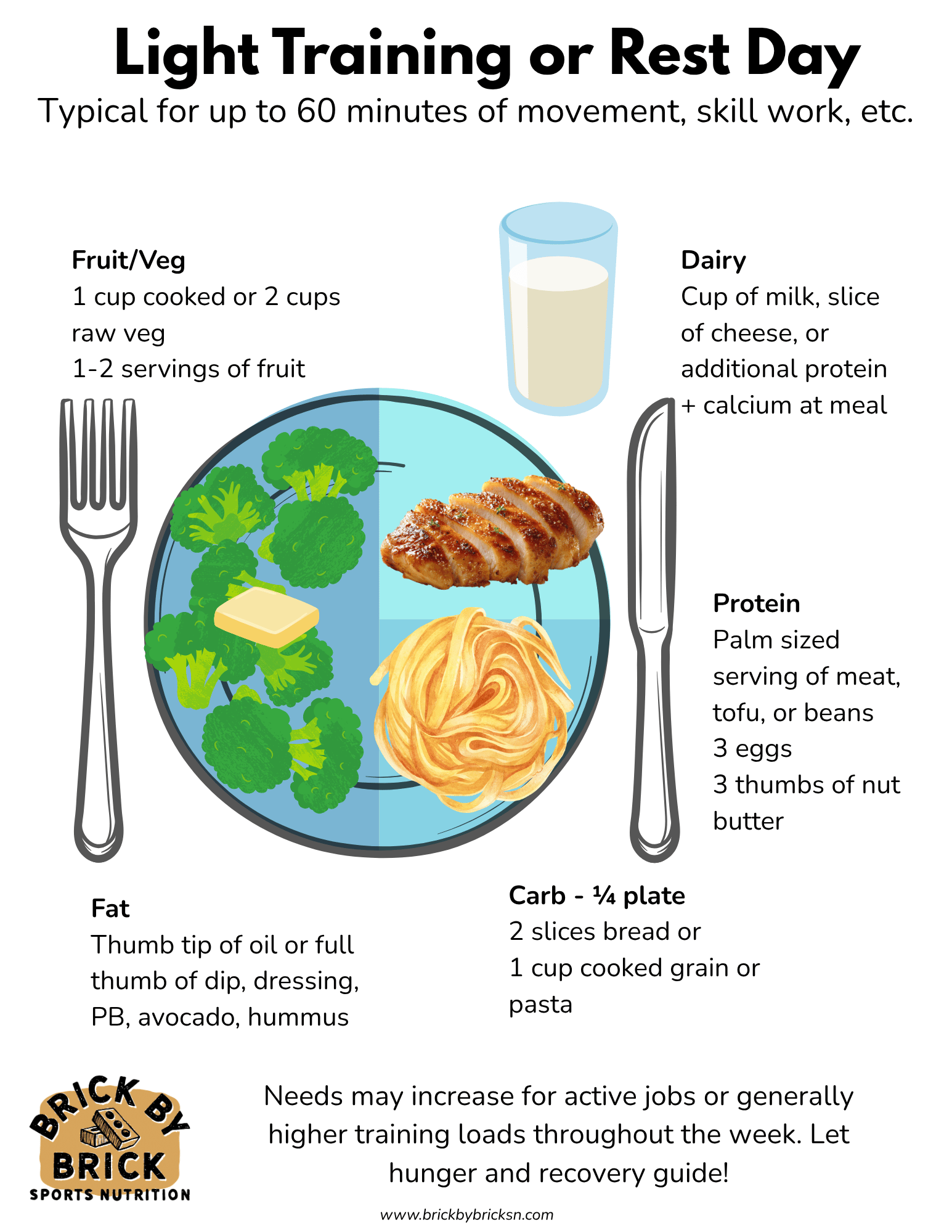
A Light or Rest Day Plate is adequate for up to 60 minutes of light-moderate activity which also includes stretching and skill work. About a quarter of the plate is a source of protein, ¼ of the plate is starch (about a fist-sized serving of rice, a roll, or a large slice of sourdough bread). About half of the plate will be a source of “color” from a fruit or vegetable. You’ll also want to include about a thumb tip (about a teaspoon of oil) to thumb-sized serving of fat (hummus, dressings, avocado, etc.) at minimum, which can easily be met by cooking a vegetable in oil or including a dip of some sort. I encourage athletes to include a source of calcium at each meal. This is most easily achieved through dairy or fortified non-dairy milk. Calcium is especially important for runners and those who are at higher risk for bone stress injuries.
A Note on Rest Days
Some plate models include a Rest Day plate but to be honest, most athletes don’t need to dial back drastically on rest days. Carbohydrate stores (glycogen) take time to regenerate and rest days are important for recovery across a training week. Some athletes find that rest days are where their hunger kicks up, especially if they don’t have a great appetite around training or their schedule makes it difficult to get in enough fuel. Rest days can be used to their advantage rather than accidentally falling behind on fueling.
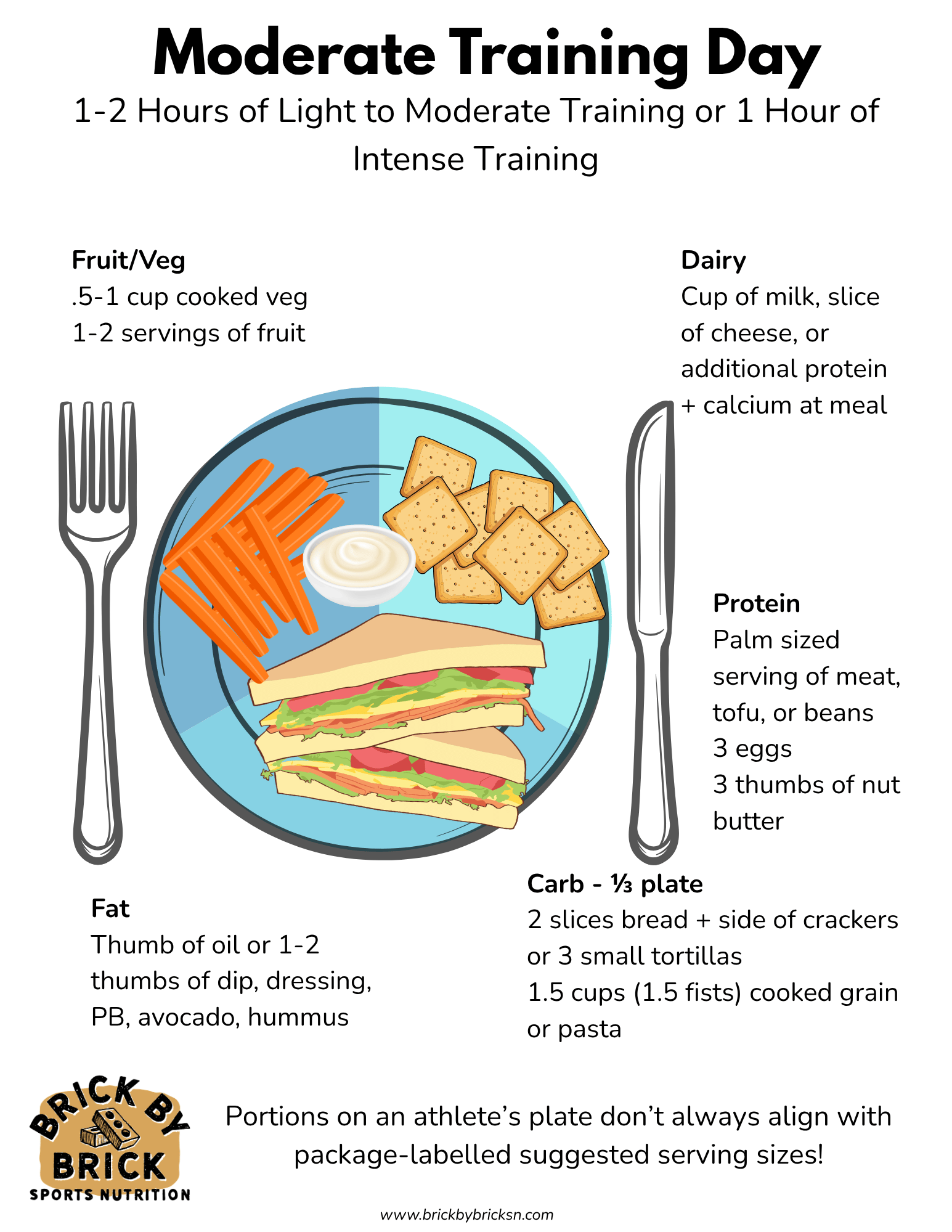
With a Moderate Day Plate (1 hour of higher intensity or 1-2 hours of light-moderate intensity) , we want to account for the increase in demand for energy and carbohydrate by dialing up both at meals. We can do this by increasing the carb component to 1/3 and upping the fat to about a thumb’s worth of oil or 1-2 thumbs-sized portion of less-concentrated fat (hummus, sour cream, salad dressing, avocado, etc.) Produce now takes up about a third of the plate to make room for the rest.
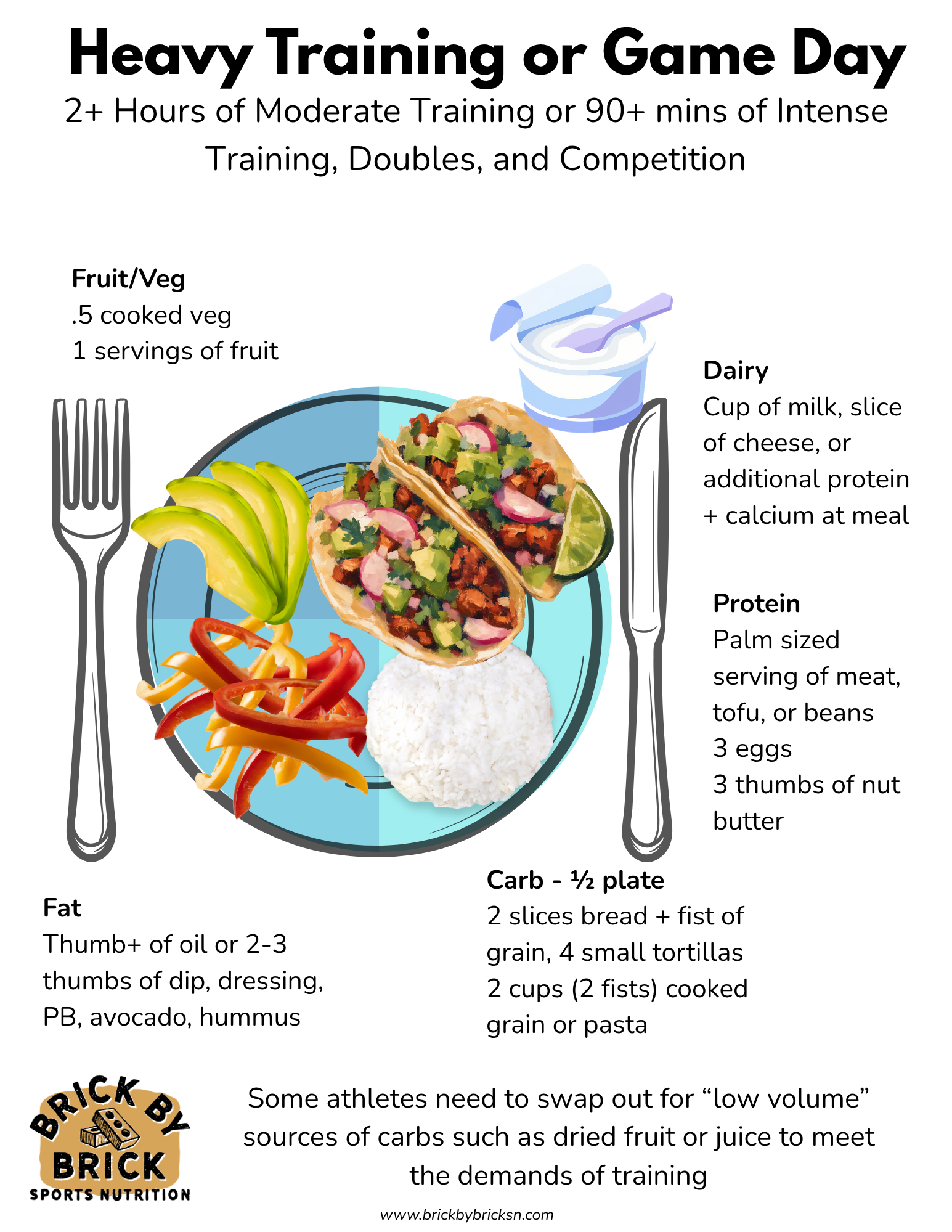
Heavy days might look like 2 hours of intense training or strength training mixed with a cardio session.
Both carbs and fats need to be bumped up here and produce (color) dialed back to match priorities. Carbs will take up half the plate and fats will range from a full thumb plus of oil to 2-3 thumbs of fats like avocado, hummus, and dressings. If appetite is blunted, you can substitute some of the carbohydrate and/or fats for a dessert on the side or go for low-volume carbs like dried fruit or fruit juice.
From here, the sky is the limit. I like to also include fueling snacks around training, and for longer sessions including fuel during the session. Fuel timing will be included in part 2.
Variety
After balanced plates comes the next principle: variety.
Whereas some nutritional approaches focus on limiting and restricting certain types of food, I have found that to be an unhelpful centerpiece. An emphasis on variety is more productive and better supports a positive relationship with food.
Including a variety of protein and fat sources, carbohydrate sources, and fiber sources helps meet dietary needs. Generally, this is enough to ensure that one is not overdoing or underdoing any particular aspect of their nutrition without overthinking it.
A highly varied diet also helps support a diverse microbiome and meets most vitamin and mineral needs.
This is where it can be helpful to take a stroll around the farmer’s market to see what’s in season or explore the freezer aisle to see if there are some interesting veggie blends worth trying.
Many athletes find keeping a pantry and freezer well-stocked with staples helps keep a rotation of varying grains, proteins, and produce sources.
Satisfaction
Athletes can often fall victim to “optimization-maxxing” where food is seen solely as fuel and something to perfect. This often comes at the cost of mental wellness and other nourishing aspects of food.
Choosing satisfying, enjoyable foods is key for developing flexibility and moderation with eating.
Remember that satisfaction doesn’t have to exist in isolation– it can peacefully co-exist with adequacy, balance, and variety.
If you’re feeling nervous about intentionally including satisfying foods, take a deep breath:
Satisfaction is one of the most underutilized tools when it comes to sustainable fueling.
Feeding yourself is basically a part-time job. There must be some level of enjoyment included, or you will struggle to keep doing it consistently.
No matter your performance ambitions, there is no such thing as a perfect diet. As a dietitian, I can assure you that a nutritious diet absolutely can include all foods you enjoy.
Nutrition is about the bigger picture: what happens week-to-week and month-to-month, not meal-to-meal. What you ate for lunch is a very small piece of the puzzle. And mental wellness around eating matters just as much (if not more!) because it affects both physical health and performance.
Nutrition should absolutely not be a source of suffering and deprivation and you shouldn’t feel like you need to “cheat” on it.
I recommend athletes intentionally include foods that bring them joy with full permission. If you struggle with food guilt or feeling like you need to restrict or exercise more after eating, this is where working with a specialist can help untangle these feelings and break unhelpful eating cycles.
Now, how do you know your fueling is right?
Feedback
To be sure, the best-case scenario is checking in with a dietitian. But I also like athletes to be aware of the signs of underfueling. If you’re a club athlete or recreational athlete, you absolutely can have low energy availability or Relative Energy Deficiency in Sport (REDs), but you might not have a sports medicine team screening for it.
These require attention:
Irregular periods, absence of a period, or a cycle lasting >35 days
Drop in sex drive in males
One in isolation is less worrisome, but multiple signs can point towards underfueling:
Poor mood, focus, or motivation
Sleep disruption
GI disturbance including constipation or food intolerances
Always feeling cold
Weight fluctuations or instability
Overuse injuries
Sugar cravings or binges
Urinary incontinence
Excess soreness, fatigue, or inability to handle training loads throughout the course of a week
Low iron or ferritin (work with a medical professional to order and interpret labs)
Decline in mental health and/or rigid thinking patterns
Feeling fearful or anxious about eating with others
While these can be signs of underfueling, absence of these signs doesn’t necessarily mean that fueling is optimal.
Here are some positive signs that fueling is going well. Generally, well-fueled athletes:
Do not completely empty their cup and collapse on the couch after a hard workout.
See gains from training through an improvement in fitness and/or strength.
Look forward to and enjoy training and more easily feel “in the zone”
Recover from soreness and “heaviness” quickly
Feel confident in their fueling and while it takes up some space in their brain, it doesn’t push out everything else.
These, in combination with reflecting back on fueling patterns can help paint a more complete picture.
Some individuals might warrant a little extra attention or support off the get-go as it’s easy for fueling to go awry. For example, those whose sport has a weight or aesthetic component may want to be proactive with speaking with a licensed nutrition professional. Those with restricted diets such as individuals with celiac disease or those following a vegetarian or vegan diet may benefit from additional support as well to ensure nutrient needs are met. Vegetarians in particular may benefit from including energy-dense sources of carbohydrate and fat because a higher-fiber diet can make it difficult to get enough energy as an athlete.
A Final Note:
If you’re in charge of figuring out your fueling, remember that it’s a process of learning and iterating; fueling needs may change throughout a season or training cycle. You might not have a team dietitian as a club, rec, or everyday athlete, but that doesn’t mean you can’t have a nutrition pro in your corner! If you want more support with your fueling, apply to work with me here.
In part 2, we’ll focus specifically on fuel timing around training. If you subscribe to the newsletter, you won’t miss it!

Em Palmerton is a sports and eating disorders specialist dietitian, former rugby player, and dog mom based out of Buffalo, NY. She is the founder of Brick by Brick Sports Nutrition.