


3 Reasons Your Nutrition Falls Apart When Life Gets Busy
If you’re an active human that feels guilty taking a snack break, listen up because this one is for you!
Here’s what I see all the time:
Athletes are trying to raise the ceiling of their nutrition before they’ve built the basement.
The ceiling is what we believe will bring us optimal performance and gains– the supplement stack, periodized macro splits, and weighing every single bite.
The basement is what you’re able to do on the hard days. The busy weeks. The days when you’re tired, stressed, traveling, and don’t have the brain space to nail your nutrition. This is what most athletes are missing when it comes to consistency.
Don’t get me wrong– I’m not anti-discipline, but many athletes are putting discipline in the wrong places.
27 Facts You Need to Know about REDs (Relative Energy Deficiency in Sport)
Rather than give you another summary of REDs you could easily Google, I figured I’d share facts that might change how you think about energy availability, REDs, and bone health.
REDs in 27 Facts:
REDs stands for relative energy deficiency in sport. It used to be called RED-S and some of the researchers wanted people to pronounce it as “reds” instead of “red S” so they changed it. The change was also for social media sharing because RED-S was harder to hashtag!

Why Underfueled Athletes Can Feel Faster
As a sports RD, I’ve noticed this challenging spot that athletes find themselves– they may acknowledge that their current approach isn’t sustainable, but they feel stuck because when they’ve tried to change it in the past, they’ve wound up frustrated and no further ahead.
There is a very real conundrum of feeling like performance is improving while simultaneously running on empty.
We must talk about this phenomenon because it’s one of the biggest reasons athletes rule themselves out of having low energy availability: they don’t feel bad. Their training doesn’t necessarily feel worse. They may feel quick. They may feel focused, more prepared even.
Energy Availability Explained
We have to understand that a body’s first priority is always survival, not necessarily long term health or reproduction. When survival is threatened, bodies often respond in predictable ways.
The demands of physical activity, whether it’s training, walking your dog, or a 5 mile run, will be prioritized because the need is immediate.

Can a Dietitian Help with Body Image?
Although the word “dietitian” literally has the word “diet” in it, folks are often surprised in working with me how little we can talk about food itself.
A Fresh Take on the Female Athlete Triad and Bone Stress Injuries
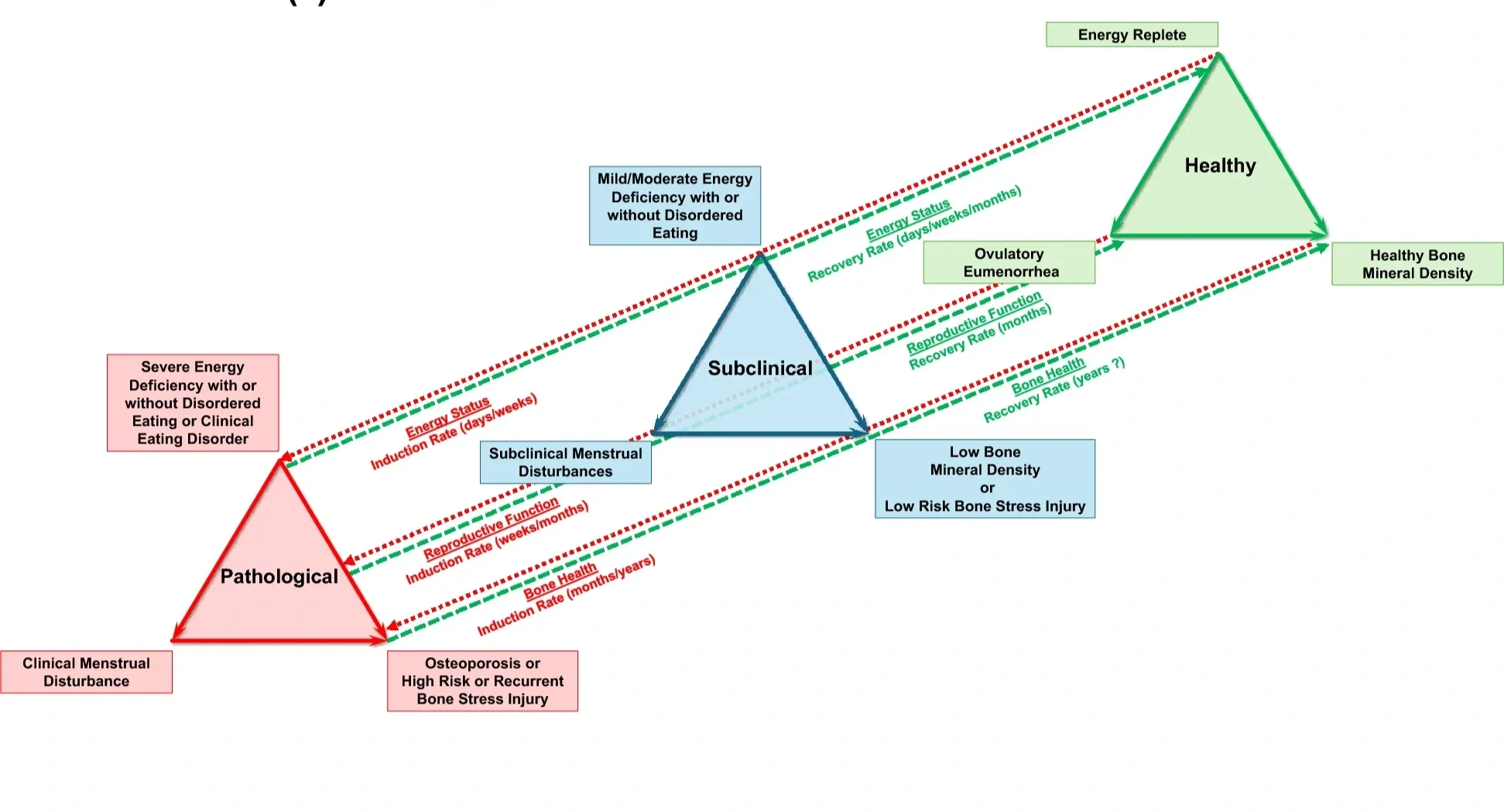
Dealing with my own tibial fracture and working with more athletes navigating bone stress injuries has catapulted me into the literature on bone health and healing, particularly in athletes. This led me to finally take the time to sit down and dissect the updated Female Athlete Triad consensus statement.
While it has helped me update my knowledge and clinical protocols, it’s also been validating to see additional evidence of what I’ve been preaching for years, especially on why so many nutrition issues are missed by otherwise savvy providers and athletes.

Body Image on a Broken Leg
The surprising ways in which body image shows up after a traumatic injury happens on the field.
Common Nutrition Mistakes Athletes Make
As a sports dietitian, I see a lot of the same nutrition mistakes show up across sports, levels, and seasons. Most of the time, these mistakes aren’t because athletes don’t care or aren’t disciplined enough—they’re usually the result of confusing, oversimplified, or flat-out bad nutrition advice.
Learning to Learn: A Dietitian’s Journey
How learning instructional design is showing up in client sessions and workshops. Spoiler: education doesn’t have to be boring!
Does Intuitive Eating Work for Athletes?
Intuitive eating has been gaining popularity and has many active folks wondering— is intuitive eating for me?

When and How to Refer to a Nutrition Pro
If you’re an athlete provider- coach, trainer, or PT- you know you’ve run into athletes who need support of a dietitian but aren’t sure how to bring it up or talk about it. This one is for you!

Thinking Beyond the Scale: A Case for Weight-Neutral Nutrition
Why I’ve shifted away from using the scale as a marker of success. You might want to, too!

I Already Know What to do…
If you have all the knowledge but can’t seem to apply it consistently, read this!

Why I’ve Changed My Mind on Accountability
One such idea was that paying someone simply for accountability was a giant waste of money. At the time, I would not have argued against hiring a coach, but was vehemently against the idea of making that investment simply because it would make you take action. I believed that what really needed to happen was an improvement in one’s accountability to oneself, which would be rooted in self-respect of boundaries and would make a coach obsolete. I think what was really happening was my own fear of being held responsible for someone else’s success was very activating for me, and I denied the whole process as a result. Since then, I’ve changed my tune. Here’s why:
Two things can be true: it’s not my job as the coach to take action and I am an important catalyst for change. I see myself as more of a tour guide and my client is the one “driving the bus”. I am holding the map, I can help you see what roads are blocked, and I certainly offer up a mirror to reflect things that you might be missing. I’m not the one applying the gas pedal but I can be there when you’re afraid of missing the turn.